
 Home
Home Credit Cards
 Personal Loans
 Car Loans
 Home Loans
 Business Loans
 Bank Accounts
 Calculators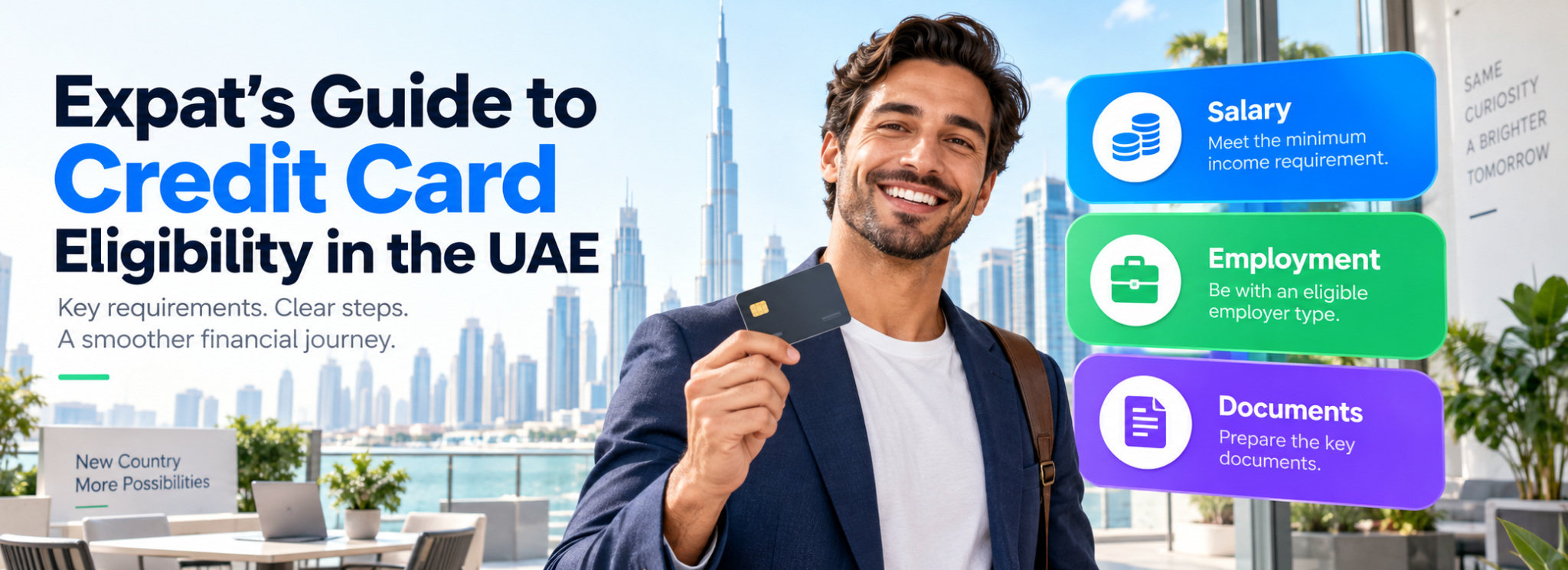
- UAE credit card eligibility for expats depends on the overall financial profile, not nationality alone.
- Current UAE rules set AED 60,000 annual income as the standard minimum for normal credit card issuance.
- Employment stability, existing debt and credit history can influence the issuer’s decision.
- New UAE residents may have a shorter local credit history, so income and documentation can become particularly important.
- Compare cards that fit both your eligibility profile and the way you actually spend.
Expat’s Guide to Credit Card Eligibility in the UAE
Moving to the UAE often comes with a long financial checklist.
Open a bank account. Arrange salary payments. Set up utilities. Start building a local financial history.
Then comes another common question:
Can I get a credit card as an expat?
For many UAE residents, the answer can be yes - but eligibility is not based on residency status or salary alone.
Credit card issuers may look at your income, employment, existing obligations, credit history and supporting documents before deciding whether a particular card fits your profile.
That means two expats earning the same salary can still receive different outcomes.
Salary is the first filter, not the final decision
Salary is usually one of the easiest ways to narrow down which cards may be relevant.
Current UAE Central Bank rules specify a minimum annual income of AED 60,000 for normal credit card issuance, equivalent to AED 5,000 per month. Banks can then set their own product-level requirements within their credit policies.
That distinction matters.
A card advertised with an AED 5,000 minimum salary is not automatically available to everyone earning AED 5,000.
Likewise, someone earning AED 15,000 is not automatically approved for every card within that salary range.
Think of salary as the starting filter.
After that, the issuer still needs to determine whether extending credit is appropriate for your overall financial situation.
Being an expat is not the problem - your financial profile matters
The UAE has a large expatriate population, and credit cards are commonly offered to eligible residents.
The more relevant question is whether your financial profile gives the issuer enough confidence that the credit can be serviced responsibly.
CBUAE responsible-financing rules require financial institutions to assess factors including the consumer's financial obligations, income and creditworthiness before extending credit.
For an expat applicant, that can make employment stability particularly relevant.
Someone who has been working in the UAE for several years with consistent salary credits may present a different profile from someone who arrived recently and has just started a new job.
This does not mean new residents cannot obtain credit cards.
It simply means lenders may have less local financial history to work with.
New to the UAE? Your local credit history may still be developing
This is one of the biggest differences between applying for a credit card in your home country and applying after moving to the UAE.
A strong credit history abroad does not automatically become a long UAE credit history.
Etihad Credit Bureau provides UAE residents with access to their local Credit Report and Credit Score, including information such as credit contracts and payment history.
If you have only recently moved to the country, there may simply be less local history available.
That does not automatically mean your application will fail.
It may mean other parts of your profile - such as salary consistency, employment, existing commitments and documents - carry more importance during the assessment.
Over time, responsibly managing local financial commitments can help establish a more complete UAE credit record.
Existing debt can matter as much as salary
A high salary does not necessarily mean high borrowing capacity.
Suppose one applicant earns AED 20,000 but already has a personal loan, car finance and several card commitments.
Another earns AED 12,000 but has very little existing debt.
The second applicant may have more room in the monthly budget.
This is why Debt Burden Ratio, or DBR, matters.
DBR helps show how much of your regular income is already committed to debt repayments. UAE lending rules generally require total repayment obligations to remain within prescribed limits and require lenders to assess the customer's actual ability to repay.
For expats, this means moving to a higher salary does not necessarily solve an eligibility issue if existing debt has increased at the same time.
Before applying, look at your complete financial picture.
Employment stability can influence the application
For salaried expats, the issuer may also look at how stable and verifiable the income appears.
This can include factors such as how long you have been employed, whether your salary is credited regularly and the lender's internal treatment of your employer or employment profile.
Some applicants may also encounter different criteria while on probation or shortly after changing jobs.
There is no single employment rule that applies to every UAE credit card.
Each issuer can apply its own product and risk criteria.
That is why copying a colleague's experience can be misleading.
Two employees sitting next to each other may earn similar salaries and still qualify for different products.
Documents need to support the application
A credit card application is not only an eligibility check.
It is also a verification process.
Depending on the issuer and applicant profile, supporting information may include identification, UAE residency details, employment evidence, salary information or bank statements.
The exact requirements vary.
What matters is consistency.
If your salary certificate shows one amount but the banking history shows something very different, the lender may need further clarification. The same applies when employment or personal details are outdated.
For a recently arrived expat, having clear and current documentation can make the process easier to assess.
Do not assume that meeting the salary requirement means the paperwork is just a formality.
What about your credit score?
Credit scores can be useful indicators of creditworthiness, but they should not be treated as an approval switch.
Etihad Credit Bureau describes the credit score as a numerical representation of creditworthiness based on factors within the credit history, including payment behaviour and debt.
The final lending decision remains with the financial institution.
There is therefore no universal score at which every UAE credit card suddenly becomes available.
A lender may consider the score together with income, existing debt, employment, requested credit limit and its own internal policy.
The better approach is to maintain healthy credit behaviour rather than chase a particular number simply to apply for one card.
Which credit card should an expat choose?
Once eligibility is clearer, the next step is choosing a card that fits life in the UAE.
A frequent traveller may care about miles, airport lounges and overseas spending.
A family may find grocery, dining or fuel cashback more practical.
Someone establishing their first UAE credit card may prefer a straightforward card with manageable fees rather than paying for premium benefits they rarely use.
This is where the distinction between qualifying for a card and choosing the right card becomes important.
Do not take a card simply because it is the first one offered.
Compare what it costs, what it rewards and whether those benefits match your actual spending.
Avoid applying everywhere at once
New residents can sometimes treat credit card applications like shopping enquiries: submit several and see which one works.
A more selective approach is better.
First understand your salary range, existing obligations, employment position and credit profile.
Then narrow the comparison to cards that appear suitable.
This avoids unnecessary applications and makes the process more deliberate.
If an application is declined, understanding the possible reason is usually more useful than immediately submitting several more.
The issue may be temporary, such as short employment history, or it may relate to existing obligations or lender-specific criteria.
Build your UAE financial profile gradually
For new expats, there is no need to rush into several financial products immediately.
Start with the essentials.
Keep salary and banking information consistent. Make existing payments on time. Avoid taking on unnecessary debt simply because credit becomes available.
If you get your first UAE credit card, use it as a payment tool rather than additional income.
Over time, this can help establish a clearer local financial history while keeping monthly commitments manageable.
A stronger financial profile is built through consistency, not through the number of products you hold.
How FinShark helps
FinShark helps UAE residents explore credit card options based on salary, spending preferences and eligibility indicators.
For expats, this can help narrow a large market into options that may be more relevant to your income and lifestyle, whether you care most about cashback, travel, rewards or everyday spending.
FinShark does not issue credit cards or make approval decisions. Products are provided by third-party issuers and remain subject to issuer eligibility criteria, credit assessment, documentation, fees and terms.
Closing
Being an expat does not automatically make credit card eligibility complicated.
The key is understanding what issuers are actually assessing.
Salary may determine where the comparison begins, but employment, existing debt, credit history and documentation can influence what happens next.
If you are new to the UAE, give your local financial profile time to develop.
And when you do compare cards, choose one that fits both your eligibility and the way you actually live.

Ready to put this into action?
Explore credit card options that may suit your profile, or estimate the numbers first with our UAE calculators. Eligibility applies.
This article is for general information only and does not constitute financial advice. FinShark is a marketing and information platform, not a bank, lender or financial adviser. Products are offered by third-party issuers and are subject to issuer eligibility criteria, fees, documentation and terms. T&Cs apply.