
 Home
Home Credit Cards
 Personal Loans
 Car Loans
 Home Loans
 Business Loans
 Bank Accounts
 Calculators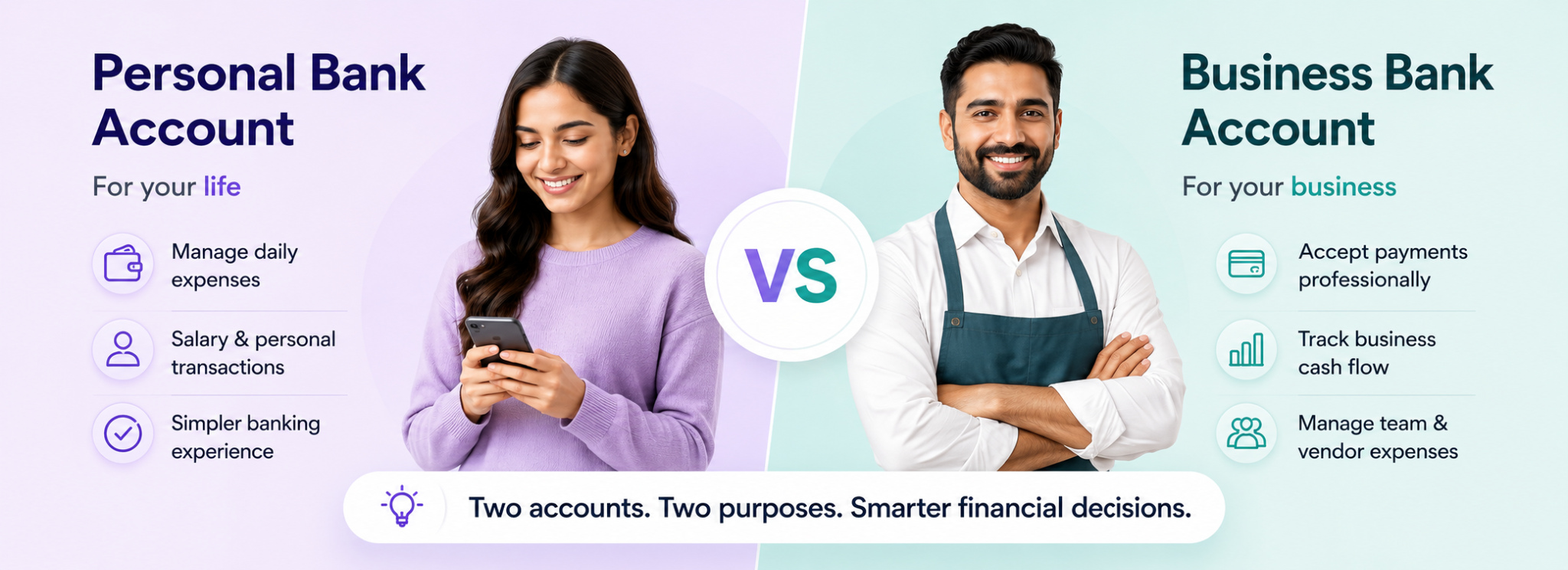
- Personal accounts are generally intended for individual income, expenses and savings.
- Business accounts are designed to manage payments and transactions connected to commercial activity.
- Business account applications may require company and ownership documentation in addition to personal identification.
- Keeping personal and business finances separate can make accounting and financial records easier to manage.
- The right account depends on how the money will be used, not simply on which account has lower fees.
Personal vs. Business Bank Accounts: What's the Difference?
A bank account is a bank account - until you start running a business.
For an individual receiving a salary, paying rent and managing everyday expenses, a personal account may be enough.
But once money starts moving through a company, freelance activity or commercial operation, the purpose of the account changes.
That is where business bank accounts come in.
While personal and business accounts can both help you receive money, make transfers and manage payments, they are designed for different types of financial activity.
Understanding the difference can help UAE residents and business owners choose an account that fits the way they actually manage money.
Personal accounts are built around individual finances
A personal bank account is generally designed for money connected to you as an individual.
That can include salary, household expenses, savings, transfers, card spending and day-to-day payments.
For most salaried UAE residents, the account becomes the centre of everyday financial life. Salary may be credited into it, bills may be paid from it and debit cards or digital banking services may be linked to it.
Personal accounts can also come in different forms, such as current accounts and savings accounts, depending on how the customer intends to use the money.
The important point is that the account is tied primarily to your personal financial activity.
It is not designed to act as the operating account of a separate business entity.
Business accounts are designed for commercial activity
A business bank account is generally intended to manage money connected to a company or commercial activity.
That could include customer payments, supplier transfers, payroll, operating expenses and other transactions related to the business.
For a company, the account can become the central place where business money enters and leaves.
This separation can be useful because it creates a clearer distinction between the finances of the business and the personal finances of the owner.
For example, if a customer pays an invoice, the money can enter the business account. Rent for the office, supplier invoices or other company costs can then be paid from that account.
The result is a much clearer financial trail than mixing everything into a personal account.
Why separating personal and business money matters
For a small business owner, freelancer or entrepreneur, using one account for everything can initially seem easier.
But it can become difficult to understand which transactions belong to the business and which are personal.
Imagine paying for groceries, receiving a client payment, paying a supplier and transferring money to a family member from the same account.
At the end of the month, identifying the true financial position of the business becomes harder.
Keeping separate accounts can make it easier to track business income and expenses, prepare financial records and understand how much money the business is actually generating.
It can also make conversations with accountants, auditors or other professional advisers more straightforward because the transaction history is easier to interpret.
Separation is therefore less about having another bank account and more about maintaining cleaner financial records.
Documentation can be very different
Opening a personal account usually focuses on the individual.
The bank may need to understand your identity, residency status, income and other information relevant to the account.
A business account can require a broader set of information because the bank needs to understand both the people involved and the company itself.
Depending on the business structure and bank, this may include company registration information, trade licence details, ownership information, authorised signatories and documents relating to the nature of the business.
Banks may also need to understand how the company operates, where its money comes from and what types of transactions are expected.
This means opening a business account can sometimes involve a more detailed review than opening a standard personal account.
The exact documents and onboarding process vary by bank, business type and customer profile.
Business accounts may offer different banking features
A business account is not simply a personal account with a company name attached.
Banks may offer services specifically designed around business operations.
These can include tools for managing payments, multiple users, business debit cards, payroll, transfers or other banking functions depending on the account.
A growing company may also need more than one person to access or approve transactions.
That is very different from a normal personal account, where the account is primarily controlled by one individual.
For a very small business, some advanced features may not be necessary immediately.
But as transaction volumes increase or more employees become involved, business-specific banking functionality can become more important.
Fees should not be the only comparison
Business bank accounts may have different fee structures from personal accounts.
Depending on the bank and account, there may be requirements related to minimum balances, transaction volumes, transfers or additional services.
A business owner should therefore look beyond whether an account appears inexpensive.
Consider how the account will actually be used.
A company making frequent transfers may care about transaction costs. A business receiving international payments may pay more attention to foreign-currency capabilities. A smaller company may prioritise manageable balance requirements and simple digital banking.
The cheapest account on paper may not be the most practical account for the business.
The same principle applies to personal banking.
Choose based on the services you genuinely need rather than comparing only one fee.
What about freelancers and sole business owners?
This can be one of the less obvious situations.
A freelancer may feel that personal and business finances are essentially the same because one person is earning and spending the money.
But once the activity operates through a trade licence, company structure or other formal business arrangement, banking requirements may be different.
Keeping a separate business account can also make it easier to see how much the activity actually earns after business expenses.
The right setup depends on the legal structure, nature of the activity and the bank's requirements.
Freelancers and sole business owners should therefore check whether their commercial activity requires or would benefit from a dedicated business account rather than assuming a personal account is sufficient.
Can you have both?
Yes. For many business owners, having both is the logical structure.
The personal account manages personal income and household spending.
The business account manages company revenue and operating expenses.
The owner can then transfer money between them in a clear and deliberate way when appropriate.
This creates a cleaner distinction between:
Money belonging to the business
and
Money being used personally
That distinction can become increasingly important as the company grows.
Which one should you choose?
If the account is mainly for salary, household expenses, personal transfers and savings, a personal account is likely the more relevant category.
If the account is being used to receive business revenue, pay suppliers or manage company expenses, a business account may be more appropriate.
For many entrepreneurs, the real answer is not one or the other.
It is both - used for different purposes.
Before opening an account, think about who the money belongs to, how the account will be used and what type of transactions will regularly pass through it.
That usually makes the decision much clearer.
How FinShark helps
FinShark helps UAE residents and business owners explore banking options based on their needs.
For individuals, that may involve comparing accounts for everyday banking.
For businesses, it may involve exploring business or SME bank accounts based on company profile and operational requirements.
FinShark is a marketing and information platform and does not open or operate bank accounts. Account availability, eligibility, documentation, fees and onboarding requirements remain subject to the relevant bank's criteria and terms.
Closing
Personal and business bank accounts may offer similar basic banking functions, but they are built for different purposes.
A personal account helps you manage your own money.
A business account helps you manage money connected to commercial activity.
For business owners, keeping those finances separate can make day-to-day management clearer and provide a better view of how the business is actually performing.
Choose the account based on how the money will be used - not simply on which option looks easier to open.

Ready to put this into action?
Explore credit card options that may suit your profile, or estimate the numbers first with our UAE calculators. Eligibility applies.
This article is for general information only and does not constitute financial advice. FinShark is a marketing and information platform, not a bank, lender or financial adviser. Products are offered by third-party issuers and are subject to issuer eligibility criteria, fees, documentation and terms. T&Cs apply.