
 Home
Home Credit Cards
 Personal Loans
 Car Loans
 Home Loans
 Business Loans
 Bank Accounts
 Calculators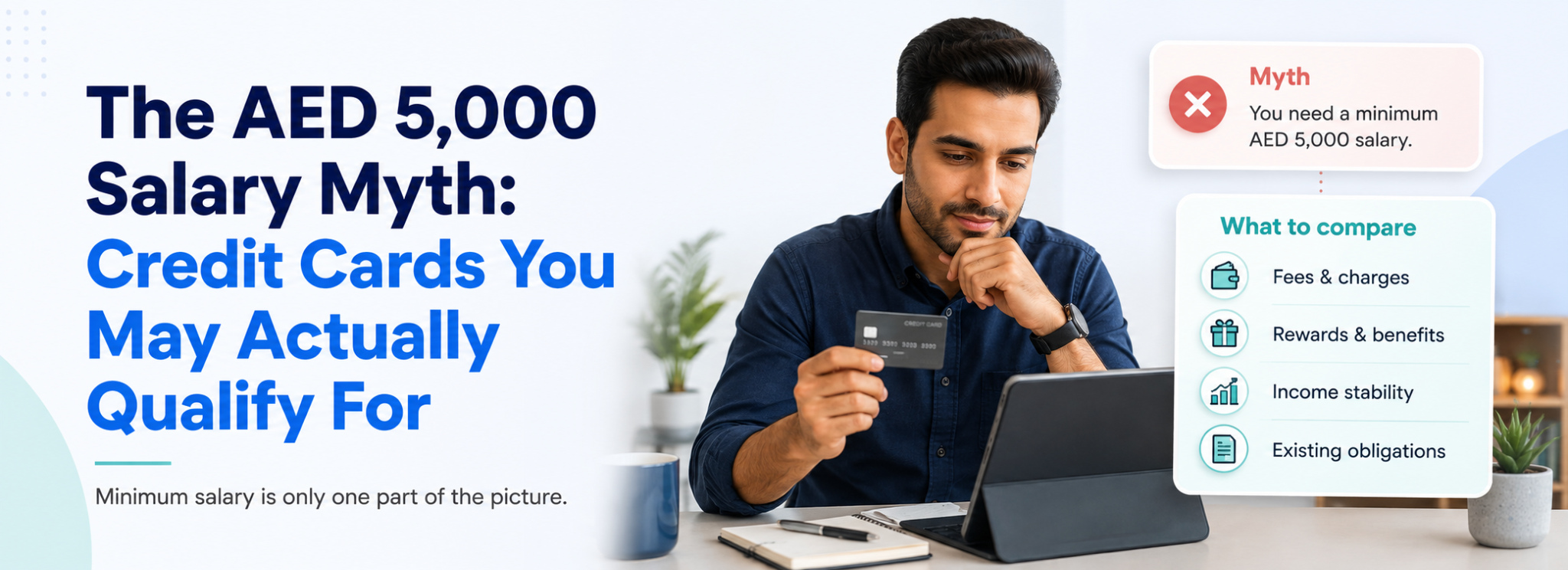
- AED 5,000 per month is a recognised starting income level for credit card eligibility in the UAE.
- Meeting the minimum salary requirement does not automatically mean an application will be approved.
- Existing debts, credit history, employment and documentation may all affect the outcome.
- At this income level, simple cards with manageable fees may be more practical than premium products.
- Compare cards that fit both your eligibility profile and your ability to repay comfortably.
The AED 5,000 Salary Myth: Credit Cards You May Actually Qualify For
If you earn AED 5,000 per month in the UAE, you may have heard two completely different stories about credit cards.
One says:
“AED 5,000 is enough. You can get a credit card.”
The other says:
“Banks will not give you anything unless you earn much more.”
Neither tells the full story.
AED 5,000 is an important figure because current UAE credit card regulation sets a mandatory minimum annual income of AED 60,000 for normal credit card issuance — equivalent to AED 5,000 per month. Some currently marketed UAE cards also publish AED 5,000 as their minimum salary requirement.
But meeting that salary threshold is not the same as being guaranteed a card.
The more useful question is:
What does earning AED 5,000 actually mean for your credit card options?
AED 5,000 is a starting point, not an approval promise
The minimum salary requirement tells you whether a card may be worth considering.
It does not tell you whether the issuer will approve the application.
Banks and other licensed financial institutions are required to assess a customer's ability to meet credit obligations, including overall indebtedness and affordability.
That means two people earning exactly AED 5,000 can receive different outcomes.
One applicant may have stable employment, limited existing debt and a clean repayment history. Another may already have several financial commitments or recent payment issues.
Their salary is the same.
Their financial profiles are not.
Why AED 5,000 keeps appearing in credit card searches
The number is not arbitrary.
The UAE Central Bank's credit card rules specify a minimum annual income of AED 60,000 for normal credit card issuance.
And selected cards currently advertised by UAE banks still show AED 5,000 as the minimum salary requirement. Emirates NBD, for example, currently lists that threshold on several cards.
This is why AED 5,000 is often treated as the starting point for credit card eligibility discussions.
But it should not be interpreted as:
“Earn AED 5,000 and every bank must approve you.”
It simply means selected products may become relevant for comparison.
What else can affect your application?
Salary is only one part of the assessment.
An issuer may also consider your employment, existing financial commitments, credit history, repayment behaviour and supporting documentation.
Your existing debt is particularly important.
If a large portion of your salary is already being used for loans, credit cards or other borrowing, there may be less room for another credit facility.
Current CBUAE rules generally cap total repayment obligations at 50% of gross salary and other regular income, while also requiring lenders to assess the customer's individual ability to repay rather than automatically lending up to that maximum.
So earning AED 5,000 tells only part of the story.
How much of that income is already committed matters too.
Your credit history can make a difference
A card issuer may also review your existing and previous credit behaviour.
That can include how you have managed other cards or loans, whether payments have generally been made on time and how much credit exposure you already have.
This does not mean there is one magic credit score required for every card.
Different issuers can apply different internal credit policies.
The practical point is simpler:
If you are earning near the minimum salary threshold, maintaining manageable borrowing and consistent repayments can become particularly important.
Your salary may get the application into consideration.
Your broader financial profile helps determine what happens next.
What kind of card should someone earning AED 5,000 look for?
At this salary level, it usually makes more sense to start with practicality rather than prestige.
A card with straightforward cashback, simple rewards or manageable annual fees may be more useful than chasing a premium card with benefits you rarely use.
Think about how you actually spend.
If most of your monthly spending is on groceries, fuel and routine purchases, simple cashback may be useful.
If you mainly want a credit card for online purchases or occasional larger payments, a basic card with reasonable costs may be enough.
The goal is not to get the most impressive card available.
It is to find a card that fits your income and your normal spending without creating pressure to spend more.
Do not judge a card only by the annual fee
No-annual-fee cards can be attractive when income is around AED 5,000 because they reduce the cost of simply keeping the card.
But “free for life” or “no annual fee” should not be the only thing you compare.
Check the overall card terms, including finance charges, late-payment fees, reward conditions and any minimum-spend requirements.
A card with no annual fee can still become expensive if balances are carried month to month.
Likewise, a card with a modest annual fee may still make sense if you genuinely use the benefits.
The right comparison is about total value and total cost.
Your credit limit is not additional income
Getting approved for a credit card can feel like suddenly having more money available.
It is not.
The credit limit is borrowing capacity provided by the issuer.
If your monthly salary is AED 5,000 and you use a large portion of your card limit, the repayment can quickly become difficult relative to income.
That is why spending discipline matters.
Use the card for expenses you already planned and understand how the statement will be repaid before making the purchase.
Rewards and cashback are useful only when they do not come with avoidable borrowing costs.
Should you apply to several banks at once?
Probably not just to “see who approves”.
A better approach is to understand your profile first and compare cards that appear realistically suited to it.
Look at your salary, employment, existing commitments and credit history before selecting where to apply.
Submitting multiple applications without considering suitability can create unnecessary credit enquiries and does not solve an underlying eligibility issue.
Selective comparison is usually more sensible than applying everywhere.
What if you earn slightly below AED 5,000?
The standard UAE credit card income rule is important here.
Current CBUAE regulation states a mandatory minimum annual income of AED 60,000 for ordinary issuance. It also provides for an alternative involving a pledged deposit for people who do not meet the income criterion, subject to the regulatory conditions and bank policy.
That does not mean every bank must offer a secured or deposit-backed option.
Availability and requirements remain subject to the bank.
If your income is below AED 5,000, a debit card or other payment option may sometimes be more appropriate than trying to obtain unsecured credit.
The smarter way to think about AED 5,000
The myth is not that AED 5,000 is irrelevant.
It is that AED 5,000 tells you everything you need to know.
It does not.
Think of salary as the first filter.
Then consider your existing debts, employment stability, credit behaviour and ability to repay.
Finally, compare only the cards whose costs and benefits make sense for how you actually spend.
That gives you a far more realistic picture of eligibility than simply searching for “credit cards for AED 5,000 salary”.
How FinShark helps
FinShark helps UAE residents explore credit card options based on salary, spending preferences and eligibility indicators.
If you earn around AED 5,000, you can start with cards that may be more relevant to your profile rather than comparing every product in the market.
FinShark does not issue credit cards or make approval decisions. Products are offered by third-party issuers and remain subject to issuer eligibility criteria, credit assessment, documentation, fees and terms.
Closing
AED 5,000 can be a meaningful starting point for credit card eligibility in the UAE.
But it is not an approval guarantee.
Your income, existing obligations, credit history, employment and documentation can all influence the final decision.
Start with cards that realistically fit your profile, keep the costs manageable and choose benefits you will actually use.
The goal should not simply be to get a credit card.
It should be to get one that fits comfortably into your financial life.

Ready to put this into action?
Explore credit card options that may suit your profile, or estimate the numbers first with our UAE calculators. Eligibility applies.
This article is for general information only and does not constitute financial advice. FinShark is a marketing and information platform, not a bank, lender or financial adviser. Products are offered by third-party issuers and are subject to issuer eligibility criteria, fees, documentation and terms. T&Cs apply.