
 Home
Home Credit Cards
 Personal Loans
 Car Loans
 Home Loans
 Business Loans
 Bank Accounts
 Calculators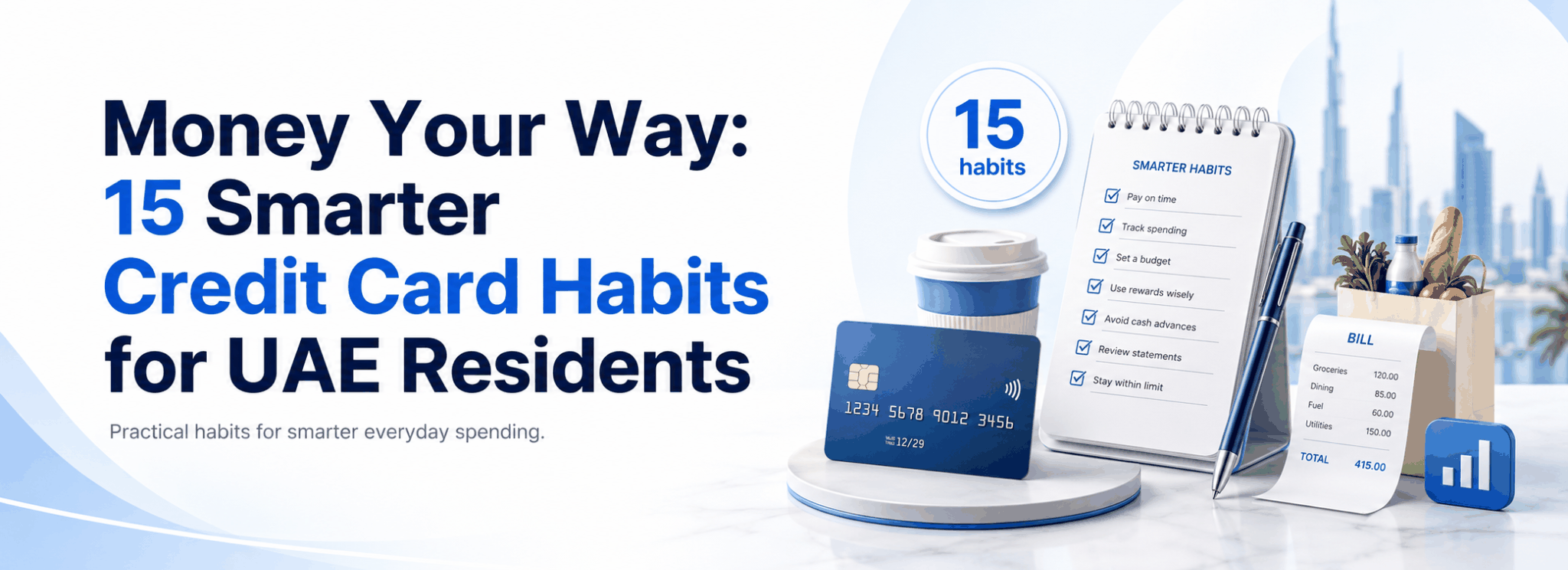
- A credit card is most useful when it supports spending you already planned, not when it encourages extra spending.
- Paying the full statement amount on time can help keep rewards from being outweighed by charges.
- Cashback, rewards and travel benefits only matter if they match your real lifestyle and spending habits.
- Fees, billing cycles, cashback caps and excluded categories can change the real value of a card.
- Using calculators before choosing a card can make repayment, interest and rewards easier to understand.
A credit card can either be a useful financial tool or an expensive habit. The difference is rarely the card itself. It is how the card is used.
Many UAE residents choose a card for cashback, rewards, lounge access, instalments or convenience. But the real value usually comes from small decisions: paying on time, understanding fees, choosing the right category, using benefits you actually need and avoiding spending just to earn points.
This is the idea behind Money Your Way. The card should work around your life, not push you into behaviour that does not fit your budget.
The habits below are not tricks in the aggressive sense. They are practical ways to make a credit card easier to manage, less expensive to misuse and more aligned with your day-to-day spending.
Here are 15 practical credit card habits that can help UAE users make smarter decisions.
1. Choose the card around your real spending
Before comparing rewards, look at your last few months of spending. Groceries, fuel, dining, school fees, travel, online shopping and bills all tell a story.
If most of your spend is local, a cashback card may be more useful than a travel card. If you fly often, miles and lounge access may be relevant. If you want simplicity, a no annual fee card may be enough.
The best card is usually the one that rewards what you already do. A card that requires you to change your spending habits too much may not be the right fit.
This is especially important in the UAE, where lifestyle spending can vary widely by household. A single professional, a family with school fees and a frequent traveller may all need different card logic.
2. Do not overspend to earn rewards
Rewards feel good, but they should never become the reason you spend more.
If you spend AED 1,000 extra only to earn a small cashback or points value, the card is controlling your behaviour. Rewards should reduce the cost of normal spending, not create new spending.
Use the card as a tool, not a challenge. The most valuable reward is often the one earned on spending you were already going to make.
A simple test helps: would you still make the purchase if there were no points or cashback? If the answer is no, pause before swiping.
3. Pay the full amount whenever possible
Credit card rewards can lose value quickly if you carry balances and pay finance charges. If you can pay the full statement amount by the due date, you are more likely to keep the card useful.
Paying only the minimum may keep the account active, but it can extend repayment and increase cost over time.
If you are using a card for rewards, full repayment discipline matters. Otherwise, the cost of borrowing can outweigh any cashback, points or miles.
For many users, this is the single most important habit. A card used for convenience and paid in full behaves very differently from a card used as long-term borrowing.
4. Understand the billing cycle
Many users focus only on the payment due date. The billing cycle is just as important.
A purchase made just after the statement date may have a longer period before payment is due. A purchase made right before the statement closes may become due much sooner.
Understanding this timing can help you manage cash flow better, especially for larger planned purchases.
This does not mean manipulating the cycle to spend more. It means knowing when your spending will appear on the statement so you are not surprised by the due date.
5. Use instalments only for planned purchases
Instalment plans can be helpful when used carefully. They may allow you to spread the cost of a large purchase over several months.
But instalments should not make an unaffordable item feel affordable. Check processing fees, tenure, early settlement rules and whether the monthly instalment comfortably fits your income.
A good instalment plan starts with a good budget. The purchase should make sense before the instalment option is considered.
It also helps to track multiple instalments separately. Several small instalments can quietly become a heavy monthly commitment.
6. Watch cashback caps
A cashback card may advertise an attractive rate, but there may be a monthly cap or category limit. Once you reach the cap, additional spending may earn less or no cashback.
This does not make the card bad. It simply means you should understand where the real benefit stops.
Caps are especially important for users who plan to put one large spending category on a card. If the monthly benefit is capped, the value may be lower than expected.
Compare cashback based on your expected monthly spend, not the headline rate alone.
7. Check excluded categories
Not every transaction earns rewards. Government payments, wallet top-ups, rent, school fees, utilities, insurance or certain merchant categories may be treated differently depending on the issuer.
Before choosing a card for a specific spending need, check whether that category actually qualifies.
This is especially important if you are choosing a card for one major recurring expense. A card that does not reward that expense may still be useful, but it should not be chosen for the wrong reason.
The merchant category can matter as much as the item you are buying. Two similar-looking payments may be treated differently depending on how they are processed.
8. Do not ignore annual fees
A card with an annual fee is not automatically bad. It can be worth it if you use the benefits well.
But the fee should be compared against real value, not imagined value. If a card gives lounge access but you barely travel, the fee may not be justified. If a card offers strong cashback that you consistently use, the fee may make sense.
The decision should be practical. Estimate the benefit you realistically expect to use in a year, then compare it with the fee and conditions.
A no-fee card can be better than a premium card if it fits your behaviour more closely.
9. Be careful with cash advances
Using a credit card to withdraw cash can be expensive. Cash advance fees and charges may apply, and the cost structure can differ from normal purchases.
Unless absolutely necessary, it is usually better to avoid using a credit card as a cash withdrawal tool.
If you need cash frequently, that may be a sign to review your monthly budget or emergency savings rather than rely on a card feature designed for short-term access.
Credit cards are usually strongest as payment tools, not cash tools.
10. Keep utilisation under control
Using a very high portion of your available credit limit can affect how your profile looks. Even if you pay on time, consistently high utilisation may suggest financial pressure.
Try to use your credit limit responsibly. If your card is frequently close to the limit, review spending and repayment habits before applying for another card.
Utilisation is also a practical comfort check. If your limit feels constantly stretched, the card may be masking a budget issue rather than solving one.
A lower balance that is paid cleanly is often healthier than a high balance carried from month to month.
11. Set payment reminders
Many card problems start with simple missed dates. A reminder before the due date can prevent late payment fees and protect repayment behaviour.
Set calendar alerts, banking app reminders or automatic payment instructions where suitable.
A small system can prevent a costly mistake. It can also reduce mental load, especially if you manage more than one card.
If you use automatic payments, still review the statement. Automation should support awareness, not replace it.
12. Use balance transfers with a repayment plan
Balance transfers can help some users manage existing card debt under a structured offer. But they are not magic.
You need to understand the transfer fee, promotional period, monthly repayment, post-promotion charges and what happens if you miss a payment.
A balance transfer should come with a clear repayment plan, not just temporary relief.
Before moving a balance, write down the amount, the monthly payment you can afford and the date by which you want the balance cleared. Without that plan, the benefit can become another cycle of debt.
13. Match travel cards to actual travel
Travel cards sound premium, but they work best for frequent travellers. Lounge access, travel insurance, miles and hotel offers are only useful if they match your lifestyle.
If you travel once a year, simple cashback may give more practical value. If you fly regularly, travel benefits may be worth comparing.
The right card depends on your real calendar. Travel benefits should be evaluated based on actual trips, not the idea of travelling more.
If your travel patterns change, review the card again. A card that made sense during a busy travel year may not be useful later.
14. Keep old cards only if they still serve a purpose
Some users collect cards over time and stop reviewing them. This can create unused limits, annual fees or scattered spending.
Review your cards once or twice a year. If a card no longer matches your spending or benefits, consider whether it still deserves a place in your wallet.
Before closing any card, check possible fees, outstanding balances and impact on your overall credit profile.
The goal is not to have the most cards. It is to have the right cards and understand why each one exists.
15. Use calculators before choosing
A calculator can make card comparison more honest. Estimate whether cashback is meaningful, whether interest costs could outweigh rewards, or whether minimum payments would stretch repayment longer than expected.
FinShark calculators are designed to help users think through these decisions before choosing a product.
A calculator will not choose a card for you, but it can reveal trade-offs that are easy to miss. It can show how repayment behaviour, rewards and costs interact.
That clarity can make a card decision feel less emotional and more practical.
How FinShark helps
FinShark helps UAE residents explore cards based on profile and spending style. Instead of chasing the loudest offer, users can compare based on salary range, benefits and financial habits.
FinShark does not issue cards, provide regulated financial advice or guarantee approval. Products are offered by third-party issuers and remain subject to issuer criteria, documents, fees and terms.
The FinShark approach is simple: understand the user first, then explore options that may be more relevant to that profile.
Closing
Credit card value is not only about rewards. It is about discipline, timing, category fit and understanding the cost of using credit.
Use your card with intention. Choose benefits you can actually use. Pay attention to fees. Keep repayments clean.
That is how money works your way.
Explore options based on your profile with FinShark.

Ready to put this into action?
Explore credit card options that may suit your profile, or estimate the numbers first with our UAE calculators. Eligibility applies.
This article is for general information only and does not constitute financial advice. FinShark is a marketing and information platform, not a bank, lender or financial adviser. Products are offered by third-party issuers and are subject to issuer eligibility criteria, fees, documentation and terms. T&Cs apply.