
 Home
Home Credit Cards
 Personal Loans
 Car Loans
 Home Loans
 Business Loans
 Bank Accounts
 Calculators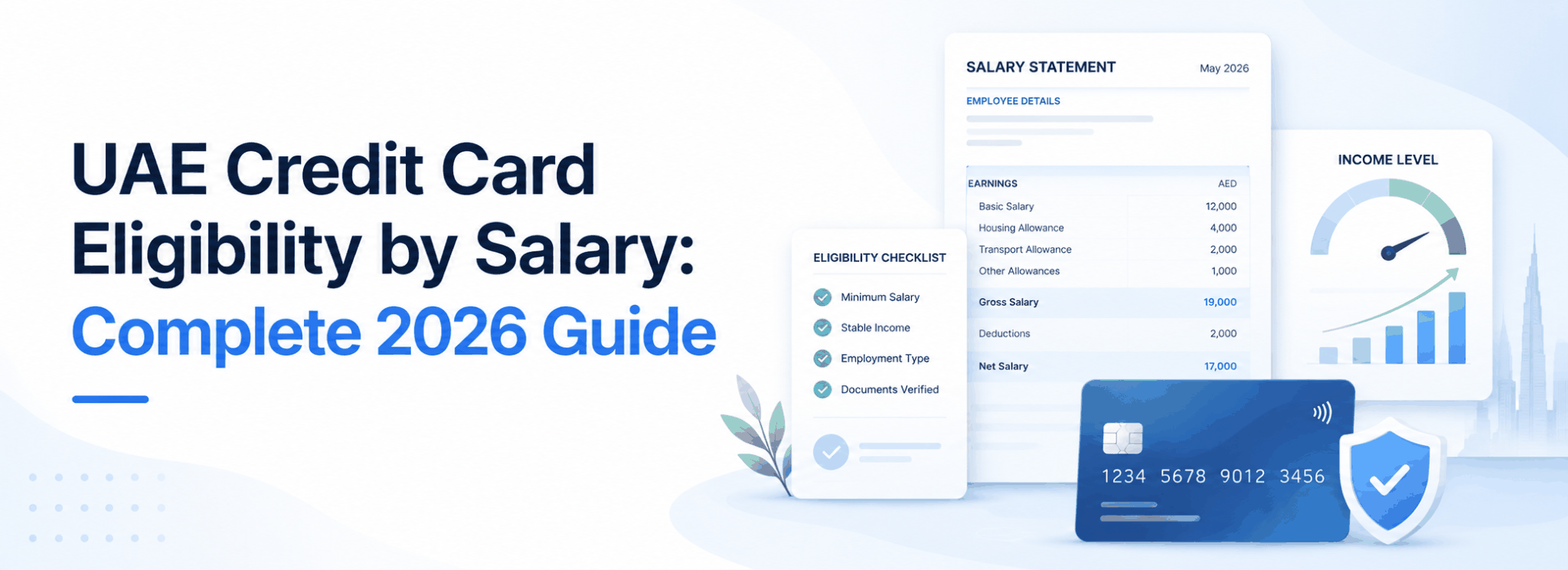
- Salary is an important starting point for UAE credit card eligibility, but it is not the only factor.
- Issuers may also look at credit history, DBR, salary transfer, employer profile and documents.
- A higher salary can open more card options, but it does not guarantee approval.
- The right credit card should match your income, spending habits and repayment comfort.
- Applying selectively for cards that fit your profile is smarter than applying everywhere.
Getting a credit card in the UAE can feel simple from the outside. You see cashback, travel perks, airport lounge access, dining offers or a welcome bonus, and the card immediately feels attractive. Then the eligibility part begins.
Salary requirement. Employer profile. Bank statement. Credit history. Existing loans. Documents. Terms and conditions. Suddenly, a simple card comparison becomes a more careful decision.
The useful way to think about credit card eligibility is this: salary starts the conversation, but your full financial profile shapes the outcome. A monthly income figure can help you understand which card categories may be realistic, but it does not replace the issuer’s full assessment.
Two people can earn the same monthly salary and still receive different responses from an issuer. One may have regular salary credits, low existing debt and a clean repayment history. The other may have high outstanding card balances, missed payments or incomplete documents. Same salary, different profile.
That is why FinShark looks at eligibility as a profile match, not just a salary number. The goal is not to push every user toward the most visible card. It is to help users understand what may be relevant before they submit an enquiry.
Why salary matters
A credit card is not only a payment card. It is a credit facility. When an issuer approves a card, it gives the customer access to a spending limit that must be repaid later.
Your salary helps the issuer understand whether your income can support that facility. It may also influence the type of card you are considered for, the documents required, and the credit limit that may be offered if approved.
In the UAE, AED 5,000 per month is often discussed as a common starting range for selected entry-level cards. This should be treated as a broad market reference, not a promise. Different issuers and cards may have different requirements, and premium cards may need stronger income profiles.
A more practical question is not “What is the minimum salary for any credit card?” It is “Which card category fits my income, employment type, repayment capacity and documents?” That question gives you a better starting point because it includes both eligibility and usability.
Salary also helps users filter out poor-fit options early. If a card is built for a higher-income profile, applying too early may waste time and create unnecessary frustration. If a simpler card fits your current profile better, it may be a more useful first step.
Salary is not the full eligibility check
A higher salary can help, but it does not automatically guarantee approval. Issuers may also review income stability, salary transfer history, employment length, employer profile, existing obligations and repayment behaviour.
For example, a customer earning AED 15,000 with several loans and high card outstanding balances may face more scrutiny than a customer earning AED 9,000 with low obligations and a clean payment history.
This is where many applicants misunderstand eligibility. They focus only on income and ignore affordability. If existing commitments are already high, another credit facility may be harder to justify.
The same logic applies to employment stability. A user who recently changed jobs may need additional salary history or supporting documents. A user with a longer salary transfer record may be easier to assess, even if the salary is not dramatically higher.
Eligibility is therefore not a single yes-or-no question. It is a set of checks that help the issuer understand whether the product is suitable for the customer’s current profile.
Lower salary applicants should focus on fit
If your salary is near the entry range, the goal should be realistic matching. You may need to focus on simpler everyday cards rather than premium travel or lifestyle cards.
This could include cards with basic cashback, simple rewards, no annual fee features or benefits linked to regular spending. At this stage, it is better to choose a card that supports normal monthly use rather than a card that looks premium but sits outside your profile.
Your chances may be stronger if your salary is credited regularly, your documents are clear, your obligations are manageable and your repayment history is clean.
Your chances may be weaker if salary credits are irregular, documents do not match, your employer is difficult to verify, you have recent missed payments or you have applied for multiple credit products in a short period.
Lower salary does not mean a credit card cannot be useful. It simply means the card should be chosen with more care. A simple card used responsibly can be more valuable than a premium card that creates pressure or encourages unnecessary spending.
Mid-income applicants have more choice
Once your income moves beyond the entry range, more card categories may become relevant. You may begin comparing cashback cards, dining cards, fuel cards, shopping cards, basic travel cards or rewards cards.
This is where the decision becomes less about eligibility alone and more about usefulness. More options can be helpful, but they can also make the comparison feel noisier.
A card may advertise cashback, but the cashback may be limited to certain categories. Another card may offer travel benefits, but those benefits may not matter if you rarely travel. A third card may promote a welcome offer, but only if you meet a minimum spend that does not fit your normal habits.
The right card should match how you already spend, not push you into spending more just to feel rewarded. A mid-income user who spends heavily on groceries and fuel may need a very different card from someone who books flights every month.
This is also the stage where users should begin comparing cost, not just benefits. Annual fees, foreign currency charges, late payment fees and finance charges can all affect the real value of a card.
Higher salary applicants should still compare carefully
A higher salary may open premium cards with lounge access, miles, travel insurance, concierge features or lifestyle privileges. These can be valuable for the right customer.
But premium does not always mean better. A premium card only works when the benefits are actually used and the cost makes sense for your lifestyle.
If you travel often, a travel or miles card may make sense. If most of your spending is local, a strong cashback card may be more useful. If you usually pay your card in full, rewards may matter more. If you sometimes carry balances, fees and finance charges become more important than perks.
A premium card should pass one simple test: will I actually use the benefits enough to justify the cost and conditions? If the answer is unclear, it may be worth comparing simpler categories as well.
Higher salary can give you more options, but it should not remove discipline from the decision. The strongest card is still the one that fits your real financial behaviour.
Self-employed applicants are assessed differently
Self-employed applicants are not always assessed in the same way as salaried employees. Instead of only salary credits, issuers may review business bank statements, trade licence, average balance, business stability, personal banking behaviour and existing liabilities.
Consistency matters. A stable business profile with clear statements may be easier to assess than irregular deposits, unclear income movement or frequent account issues.
Self-employed users should also be careful with assumptions. A salary-based article may not fully reflect how their profile will be reviewed. The issuer may need to understand both the business and the individual applicant.
This makes preparation important. Clean statements, current documents and a clear view of existing obligations can reduce friction during the process.
Credit history and DBR matter
Your credit history can influence how an issuer views your application. Clean repayment behaviour may support your profile, while missed payments, high utilisation or unresolved obligations may raise concerns.
DBR, or debt burden ratio, is another important concept. In simple terms, it looks at how much of your income is already committed to repayments. If existing obligations are high, a new card may be harder to approve even if salary is strong.
Before applying, it is worth checking current loans, card balances and monthly commitments. FinShark’s DBR calculator can help users think through affordability before comparing cards.
This step is especially useful if you already have a personal loan, auto loan or multiple card balances. A new credit card should not make your monthly position feel stretched.
Documents can slow down the process
The exact document list depends on the issuer, but applicants are commonly asked for identification, income proof and bank statements. Self-employed applicants may need additional business documents.
Good documents do not guarantee approval, but unclear or mismatched documents can create delays. Names, salary details, employer information and bank statement activity should be consistent wherever possible.
A common mistake is treating documents as a final formality. In practice, documents are part of the assessment. If they do not support the information in the application, the process may need more follow-up.
Before applying, check whether your Emirates ID, passport, visa details, salary documents and bank statements are current and readable. A clean file helps the issuer assess the case more efficiently.
How to compare based on salary
Start with your salary band, then narrow the decision with three questions.
First, is this card realistic for my profile? Second, does it match how I spend? Third, are the fees, charges and conditions acceptable for the way I plan to use it?
This approach is more useful than chasing the most visible offer. The best card for your profile is not always the card with the biggest headline benefit.
It also keeps the decision more balanced. A card can be attractive and still be a poor fit. Another card can look simple and still deliver stronger day-to-day value.
When in doubt, compare category first. Cashback, travel, rewards, no-fee, Islamic and balance transfer cards all serve different needs. Your salary helps narrow the field, but your spending habits should shape the final shortlist.
How FinShark helps
FinShark helps UAE residents explore credit card options based on practical profile inputs such as salary range, employment type, preferred benefits and spending style.
FinShark does not issue cards or make approval decisions. Products are offered by third-party issuers and remain subject to issuer criteria, documents, fees and terms.
The value is in starting with more clarity before you submit an enquiry. A user who understands their salary band, obligations and spending style is better placed to compare realistic options.
FinShark’s role is to make that starting point easier.
Closing
Credit card eligibility in the UAE is not decided by salary alone. Your income matters, but so do your repayment history, existing commitments, documents and the card category you choose.
Before applying, take a step back. Understand your profile, compare realistic options and choose a card that fits your financial life.

Ready to put this into action?
Explore credit card options that may suit your profile, or estimate the numbers first with our UAE calculators. Eligibility applies.
This article is for general information only and does not constitute financial advice. FinShark is a marketing and information platform, not a bank, lender or financial adviser. Products are offered by third-party issuers and are subject to issuer eligibility criteria, fees, documentation and terms. T&Cs apply.